How We See Color
How Color Works Reflected color and projected color represent two distinct ways that color is perceived, each involving different methods of producing and experiencing color. Reflected Color (Ink): Reflected color is the result of light reflecting off a surface, such...
The essence of what it means to be digital.
Two Ways to Represent Information: Digital vs. Analog Digital information is different from analog information. Analog is continuous and can vary smoothly (like the way a traditional clock's hands move). Digital information is discrete and divided into separate values...
We were asked to connect what we talked about in class (9/18/24) to our learning objectives for the course. I picked out two learning objectives that stood out the most to me during this class session.
- Classify objects or concepts (from 3400 B.C. to modern) as digital or not digital.
- Explain the advantages and limitations of a digital representation in a historical as well as modern context.
Before diving much into the telegraph, we picked out some things that we thought could be analog or digital (Objective #3). We learned that for something to be analog, there has to be a continuous variation at all times. There has to be endless possibilities. Here is what we found:
- A painting would be considered analog.
- Shakespeare created his work using a digital medium meaning that it could be preserved for longer. This means that there was noise (wear down over time) that could be recovered.
- Sheet music is digital because there are not infinite possibilities of where the notes are placed, however, a musical performance would be considered analog because there are infinite possibilities of how the music could sound (This is my favorite example)
- Mail (letters) are a tough one to differentiate, because the letters of the alphabet are digital, however the message is analog.
- The alphabet, phonetic alphabet, morse code, and other set means of communication are considered digital.
- To segue into telegraphs, a telegram would be considered analog because of the continuous electric signals.
Telegraphs:
What even is a telegraph?
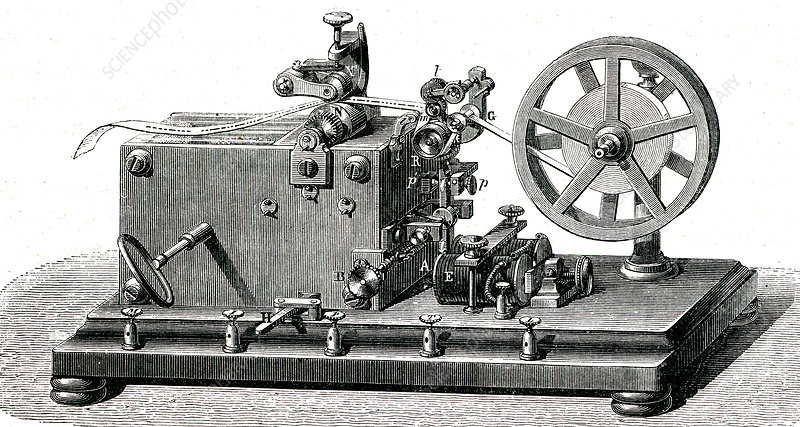
Before this class discussion, I had heard about telegraphs for years, but I never actually knew how it truly worked. A telegraph is a point to point messaging system that was created for faster communication during this time. These messages are transmitted by using electric signals. When a message is sent, it travels through a copper wire creating a beep on the other end. Because there was no vocal communication, people had to use morse code to communicate through the telegraph by listening to/creating a system of dots and dashes.
By 1838, the very first telegraph was sent, and by 1844, the first famous telegraph was sent making this device very popular. By 1861, telegraph wires were running across the U.S. Before the Civil War there were 300 miles of wire running throughout the country, and by the time the Civil War was over there were over 15,000 miles of wire. This really goes to represent how fast technology was advancing during this time. The simplicity and ease of the telegraph is what made it so successful during this time period.
Class Objective #4: Explain the advantages and limitations of a digital representation in a historical as well as modern context.
During this class discussion, I think we touched a lot upon this objective when talking about the telegraph and other means of communication during the time period. We watched a video on these means of communication and compared a lot of the new digital representation to older ones such as the pony express (one of the first U.S. postage systems) and more.
We also talked a lot about how the telephone was a huge advancement, however the Western Union saw disadvantages and bet against it, which was obviously the short end of the bet seeing how successful the telephone came to be.
The advantages and limitations of digital representation in a historical context were seemingly endless at the time. Since the telegraph was so simple, the adaptation of new technology was a very slow process, however, once it started to pick up in the 1870s, it started steamrolling like crazy. Electricity was a booming concept, making it really hard to create which was why it was so controversial. In 1876, the first centennial phone was created making the time difference between the first telegraph and the centennial phone being only 38 years. This shows how fast everything was advancing at the time. Although telegraphs and morse code are still used today in places such as the military, the new technology has seemingly taken over the ways of the world.
Fun Fact: Before the telegraph, the fastest form of news travel was postage. “Fastest” is a very loose term considering that from New York to London, it took 12 days for a message to travel and between London to Australia, it took 73 days. If there was urgent news to send from London to Australia, 20% of the year would have already gone by until that message hit, which was why transatlantic communication was such a massive advancement.